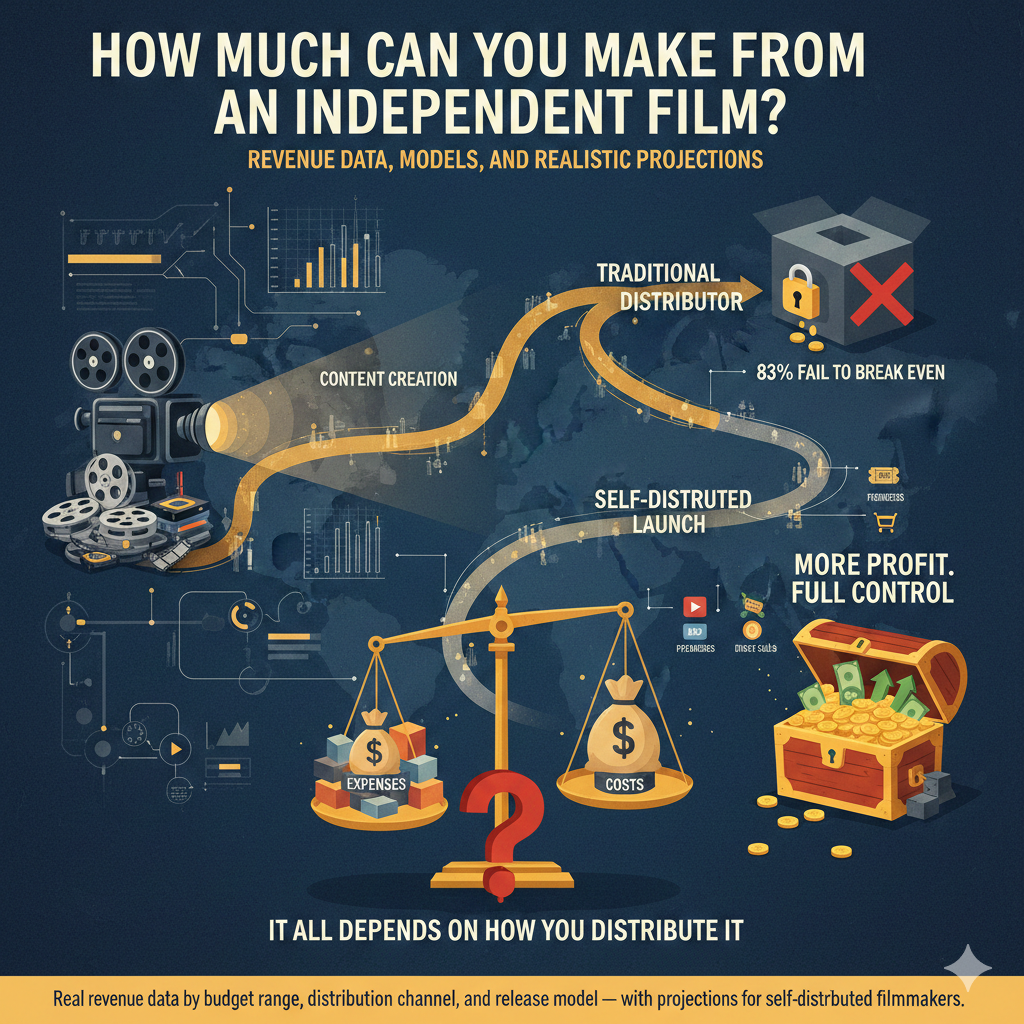
How Much Can You Make From an Independent Film? Revenue Data, Models, and Realistic Projections

The honest answer: it depends entirely on how you distribute it.
The common statistic — "only 10% of independent films make money" — is misleading because it doesn't distinguish between films that were uploaded to a marketplace and forgotten, and films that were launched with a structured distribution strategy. The distribution model changes the revenue outcome more than the film's budget, genre, or festival history.
Here's what the data actually shows. A study of 104 independent films released between 2018 and 2022 found that 83% of films distributed through traditional distributors did not break even. Meanwhile, self-distributed films — where the filmmaker controlled the release structure — had the highest probability of breaking even or generating profit (Filmmaker Magazine, 2023). The deciding factor wasn't budget or quality. It was whether the filmmaker designed a revenue structure or outsourced it to a distributor who optimized for their catalog, not for the individual film.
This article breaks down how much independent filmmakers actually earn, organized by budget range, distribution channel, and release model. It includes realistic revenue projections for self-distributed films — because that's where the data shows the best chance of return.
How Much Do Independent Films Make? Revenue by Budget Range
Revenue outcomes for independent films vary dramatically by budget range. The Filmmaker Magazine study provides the clearest available data on break-even rates, and the pattern is stark.
Films Budgeted Under $50,000
Films in this range have the highest probability of breaking even or generating a profit. The logic is simple: when your production cost is low, even modest revenue — a few thousand dollars from premieres, direct sales, and VOD — can exceed your investment. A film that cost $15,000 to make and generates $4,000 from a premiere event, $3,000 from direct sales over six months, and $1,500 from marketplace VOD has earned $8,500 — a return on investment that many higher-budget films never achieve. This is the budget range where structured self-distribution is most powerful, because the revenue needed to break even is achievable within a single launch cycle.
Films Budgeted Between $50,000 and $200,000
Films in this range have a modest but not strong chance of recouping their investment. The revenue needed to break even is significantly higher, requiring a more substantial audience and a multi-channel distribution strategy. At this budget level, self-distribution combined with a structured launch becomes essential — a passive upload to Amazon is unlikely to generate the $50,000 or more needed for break-even. Filmmakers in this range need to treat distribution as a business operation: email list, premiere event, tiered pricing, and multiple revenue windows.
Films Budgeted Between $200,000 and $900,000
This is what the study calls the "budget donut hole." Of 18 films in this range released since 2018, only one broke even. The production cost is too high for casual self-distribution to cover, but too low to attract meaningful distributor attention or marketing investment. Filmmakers in this range face the hardest structural challenge: they need the revenue performance of a well-financed release without the infrastructure to support it. The only path forward is extraordinary audience ownership — a large, highly engaged email list built before production ends.
Films Budgeted Above $1.5 Million
Films at this level that secure distribution deals with established companies can generate significant revenue — but the filmmaker's share is reduced by distributor fees, marketing expenses, and platform cuts. These films need theatrical or major streaming deals to recoup. For the majority of filmmakers reading this article, this budget range is theoretical — the data and frameworks below apply most directly to films under $200,000.
The takeaway is consistent across all ranges: the lower your budget, the more realistic it is to achieve a positive return through self-distribution. The higher your budget, the more you depend on distribution deals — which statistically fail to recoup for most independent films.
Revenue by Distribution Channel: What Each Path Actually Pays
Not all revenue is equal. Each distribution channel has different revenue potential, different revenue shares, and different audience dynamics. Here's what independent filmmakers can realistically expect from each.
Third-Party VOD Marketplaces (Amazon, iTunes, Google Play)
These are the most accessible channels — and the lowest-paying for most independent films. Amazon Prime Video Direct offers two models. The transactional model (TVOD) lets you sell rentals ($3.99–$6.99) and purchases ($9.99–$14.99) with a 50/50 revenue split. The subscription model pays per hour streamed — rates typically fall between $0.06 and $0.12 per hour for independent content. At $0.08 per hour, a 90-minute film needs 12,500 streams to generate $1,000. Without marketing support, most indie films on Amazon generate between $50 and $500 in the first year.
iTunes and Google Play offer 70/30 revenue splits (70% to the filmmaker via an aggregator). But aggregators like Quiver Digital charge upfront fees ($500–$1,500) or take an additional 15–25% cut. Net revenue to the filmmaker on a $4.99 rental becomes roughly $2.50–$3.00 per transaction. Realistic first-year revenue from marketplace VOD alone: $200 to $2,000 for an independent film without significant marketing or press coverage.
Niche VOD Platforms (Vimeo OTT, Uscreen)
These platforms let filmmakers create branded storefronts with more favorable revenue shares (80/20 to 90/10). The filmmaker sets the price and controls the presentation. However, these platforms provide zero organic discovery — every viewer must be driven there by the filmmaker's own marketing. Realistic first-year revenue: $500 to $5,000 — higher than marketplace VOD because of better margins, but entirely dependent on the filmmaker's audience size and marketing effort.
Direct Sales Through Your Own Platform
Direct sales through an ownership-first platform like TribuShare offer the most favorable economics. The filmmaker controls pricing, uses a simple per-sale fee model, owns buyer data, and can implement tiered pricing, premiere events, and scarcity-based distribution windows.
The revenue potential is directly tied to the filmmaker's email list size and launch structure. Here's a realistic projection:
| Email list size | Premiere conversion (12%) | Ticket price ($15) | Premiere revenue | 90-day purchase sales | Purchase price ($12) | Total 120-day revenue |
|---|---|---|---|---|---|---|
| 300 subscribers | 36 tickets | $15 | $540 | 20 copies | $12 | $780 |
| 600 subscribers | 72 tickets | $15 | $1,080 | 40 copies | $12 | $1,560 |
| 1,500 subscribers | 180 tickets | $15 | $2,700 | 90 copies | $12 | $3,780 |
| 3,000 subscribers | 360 tickets | $15 | $5,400 | 180 copies | $12 | $7,560 |
| 5,000 subscribers | 600 tickets | $15 | $9,000 | 300 copies | $12 | $12,600 |
These projections assume a 12% premiere conversion rate (achievable with a warm email list and a 14-day countdown sequence) and a secondary purchase window equal to roughly 50% of premiere volume. Revenue is shown in gross terms before platform fees and payment processing. Realistic first-year revenue from structured direct sales: $780 to $12,600+ depending on list size — significantly higher than many passive marketplace approaches.
Ticketed Online Premieres
A ticketed premiere is the single highest revenue-per-viewer channel available to independent filmmakers. The event framing — live screening, filmmaker Q&A, limited availability — justifies $12 to $25 per ticket, compared to $4–$7 for a standard VOD rental. Platforms like TribuShare, Eventive, and Gathr support ticketed premiere events. For a detailed operational guide, see How to Organize a Paid Online Film Premiere. Realistic premiere-night revenue: $500 to $9,000+ depending on audience size and ticket price.
Licensing and Institutional Sales
Educational institutions, nonprofits, community organizations, and corporate buyers represent a high-value, low-volume revenue stream. A single institutional screening license typically costs $50 to $200. A campus-wide annual license can cost $200 to $500. Documentaries with subject-matter relevance to educational curricula or nonprofit missions are best positioned for this channel. Realistic annual revenue from licensing: $500 to $5,000 for documentaries with active outreach to relevant institutions.
The Structured Launch Model vs. the Passive Upload: A Revenue Comparison
The difference between a structured launch and a passive upload is not incremental — it's transformational. Here is a side-by-side projection for the same film, same audience, two different approaches.
Scenario: Independent narrative feature, $25,000 budget, 800-person email list.
| Revenue channel | Passive upload | Structured launch via TribuShare |
|---|---|---|
| Premiere event (ticketed) | $0 (no premiere) | $1,440 (96 tickets × $15) |
| Direct purchase (30-day window) | $0 (no direct sales page) | $576 (48 copies × $12) |
| Amazon VOD (ongoing) | $400 (200 rentals × $2 net) | $400 (200 rentals × $2 net) |
| Replay/second window | $0 | $360 (30 replay tickets × $12) |
| Total first-year revenue | $400 | $2,776 |
| Revenue per email subscriber | $0.50 | $3.47 |
| Break-even on $25K budget | Never (at this rate) | Achievable within 2–3 launch cycles |
Same film. Same email list. The structured launch generates 6.9x more revenue in the first year — and builds a buyer database for the filmmaker's next release. The passive upload treats the film as inventory. The structured launch treats it as a product with a lifecycle. The revenue difference is the direct result of that structural choice.
Revenue Streams Most Filmmakers Miss
Beyond the primary distribution channels, independent films can generate revenue from sources that most filmmakers never pursue.
Behind-the-scenes content packages. Production footage, director's commentary tracks, and "making of" documentaries can be bundled with the film or sold separately. A $10 bonus content package sold to 15% of film buyers adds meaningful incremental revenue at near-zero marginal cost.
Group screening licenses. Film clubs, university cinema departments, community organizations, and nonprofit events will pay $50–$200 for a licensed screening. These sales require outreach but no additional production — the film already exists.
Merchandise and physical media. Limited-edition posters, USB drives with the film and bonus content, or short-run Blu-rays serve your most dedicated fans. A $30 limited-edition package with 50 units sold generates $1,500 in high-margin revenue.
Speaking and workshop fees. Filmmakers with a completed, self-distributed film have a credible case study for workshops, festival panels, and educational events. Speaking fees for independent film panels range from $200 to $2,000 per engagement.
Second and third films. The most undervalued revenue asset from a first film is the buyer list. A filmmaker who launches one film through TribuShare and captures 200 buyers now has 200 warm contacts for their second release — people who have already paid to watch their work. The conversion rate from a warm buyer list to a second film purchase is substantially higher than from a cold email list. This is the compound interest of structured distribution.
The Economics of Self-Distribution: What It Costs and What It Returns
Self-distribution is not free. There are real costs involved. But they're modest compared to the revenue they unlock — and dramatically lower than the costs absorbed by traditional distributors, which are deducted from your revenue before you see a dollar.
| Item | Cost range | Notes |
|---|---|---|
| Distribution platform (annual) | $0–$500 | TribuShare, Vimeo OTT, or similar |
| Email marketing platform | $0–$300/year | Free tier up to 500 contacts; paid tiers for larger lists |
| Sales page / website | $0–$200 | Simple landing page; included with some platforms |
| VOD aggregator (if using marketplaces) | $500–$1,500 | One-time fee for Amazon/iTunes/Google delivery |
| Marketing materials (trailer, key art) | $200–$1,000 | Can be DIY or outsourced |
| Premiere event tools | $0–$200 | Often included with hosting platform |
| Total estimated cost | $700–$3,700 |
Compare this to a traditional distribution deal, where the distributor typically deducts $10,000–$50,000+ in marketing expenses from gross revenue before the filmmaker receives any payment. Many independent filmmakers receive zero revenue from distribution deals because the expenses exceed the revenue. The self-distribution model is structurally aligned with the filmmaker's interest: every dollar spent goes toward reaching an audience that the filmmaker owns, on a platform the filmmaker controls, at a price the filmmaker sets.
Realistic Revenue Timeline: What to Expect Over 12 Months
Revenue from an independent film is not a single event. It's a sequence. Here's what a realistic 12-month revenue timeline looks like for a self-distributed film with a 600-person email list and a structured launch.
Month 1: Premiere window. Ticketed online premiere + 72-hour replay window. Expected revenue: $1,080–$1,500 (72–100 tickets at $15).
Months 2–3: Purchase window. Direct sales on your own platform at $12, promoted via email to non-buyers and social media. Expected revenue: $360–$600 (30–50 purchases).
Months 3–6: Marketplace rollout. Film goes live on Amazon, iTunes, Google Play at $4.99–$6.99 rental. Expected revenue: $150–$400 (50–100 rentals across platforms after aggregator fees).
Months 4–8: Institutional outreach. Pitch group licenses to schools, nonprofits, and community organizations. Expected revenue: $200–$1,000 (2–5 licenses at $100–$200 each).
Months 6–12: Long tail + second window. Periodic promotional emails to your list during relevant moments (holidays, anniversaries, awards season). Optional second premiere or event screening. Expected revenue: $200–$600.
Total estimated 12-month revenue: $1,990–$4,100 for a filmmaker with a 600-person email list, a $15,000 budget, and a structured launch. This is not life-changing money from a single film. But it represents a positive return on a sub-$15,000 investment — something 83% of traditionally distributed films fail to achieve. And it builds the infrastructure that makes the second film significantly more profitable than the first.
How the Independent Film Market Is Growing
The global independent film distribution market was valued at $5.4 to $6.8 billion in 2024 and is projected to grow at a compound annual growth rate of 7.1–7.2% through 2033 (DataIntelo, 2025; Growth Market Reports, 2025). North America accounts for approximately 38% of the market ($2.3–$2.6 billion in 2024).
The growth drivers are structural: proliferation of digital platforms, lower barriers to content creation, and increasing audience demand for diverse and niche content. For self-distributing filmmakers, this means a larger addressable market, more distribution tools, and audiences increasingly comfortable paying for independent content directly. The films that capture this growth won't be the ones uploaded passively to marketplaces. They'll be the ones launched with pricing structures, distribution windows, and audience relationships that convert interest into revenue.
Frequently Asked Questions
How much does the average independent film make? According to a study commissioned by the Independent Filmmaker Project, the average independent film made approximately $100,000 in total revenue. However, this figure is heavily skewed by a small number of successful titles. The median revenue for independent films is significantly lower — many generate under $10,000 in total lifetime revenue. Films that self-distribute with a structured launch consistently outperform those that rely on passive marketplace distribution.
Can you make a living from independent filmmaking? A single independent film is unlikely to provide a full-time income. But a filmmaker who releases one film per year with a growing audience can build a sustainable revenue stream. A filmmaker with a 3,000-person email list launching one film per year with a structured premiere model could generate $7,000–$15,000 annually from film revenue alone — supplemented by speaking fees, workshops, and licensing income.
How much do filmmakers earn from Netflix licensing? Netflix licensing fees for independent films vary widely — from $10,000 to $250,000+ depending on the film's festival history, cast, genre, and perceived audience appeal. However, Netflix deals are typically all-rights acquisitions, meaning you lose control of your distribution strategy and audience data. A Netflix deal for $50,000 sounds significant, but a filmmaker who self-distributes over multiple years may earn more in total while retaining full ownership.
How much do VOD rentals actually pay per stream? Amazon Prime's subscription model pays approximately $0.06–$0.12 per streaming hour for independent content. For a 90-minute film, that's roughly $0.09–$0.18 per complete stream. TVOD rentals on Amazon pay 50% of the rental price — so a $4.99 rental nets you approximately $2.50. iTunes and Google Play offer a 70/30 split, netting roughly $3.00–$4.50 per rental depending on price.
What's the most profitable distribution model for indie films? The data consistently shows that self-distribution with a structured launch — combining a ticketed premiere, direct purchase window, and marketplace long-tail — produces the best probability of break-even and profit for films budgeted under $200,000. Platforms like TribuShare are designed specifically for this model, giving filmmakers full control over pricing, windows, and buyer relationships.
How many sales do I need to break even? It depends on your budget and pricing structure. For a film budgeted at $15,000 with a premiere ticket price of $15 ($13.50 after the TribuShare platform fee, before payment processing) and a purchase price of $12 ($10.80 before payment processing), you need approximately 1,112 premiere tickets or approximately 1,389 purchases to break even from a single channel. In practice, revenue comes from multiple channels — a combination of premiere tickets, purchases, VOD rentals, and institutional licenses can cover a $15,000 budget.
Does festival success increase revenue? Festival screenings can increase revenue indirectly by building audience awareness, generating press coverage, and adding credibility that supports higher ticket pricing. However, festival laurels alone do not generate revenue. The revenue comes from converting festival attention into email subscribers, then converting subscribers into premiere ticket buyers and film purchasers. See Film Distribution After Festivals: What to Do Next for a detailed framework.
Final Thought
How much you can make from an independent film is not a fixed number determined by market conditions or luck. It's a variable determined by structure.
The same film, released two different ways, produces two different revenue outcomes. One generates $400 from passive marketplace availability. The other generates $2,776 from a structured launch with premiere events, direct sales, and deliberate distribution windows — using the same audience. The market for independent film distribution is growing. The tools for self-distribution are better than they've ever been. The question isn't whether revenue is available. The question is whether the filmmaker builds the structure to capture it.
Films don't earn revenue. Launch structures do.