The Independent Film Distribution Landscape in 2026: A Complete Framework

TribuShare TeamJanuary 13, 20269 min read
The Independent Film Distribution Landscape in 2026: A Complete Framework

Three structural shifts defining independent film distribution in 2026

The correction is painful for filmmakers who planned for the old conditions. It is navigable for filmmakers who understand the new ones.

Shift 1: Platforms have moved from content volume to audience precision. The streaming model that dominated 2019–2022 was a subscriber growth model: more content, more monthly subscribers, more revenue. That model is exhausted in mature markets. Netflix, Amazon Prime Video, Disney+, and Max have all signaled a pivot from volume to retention — acquiring less content but more strategically. The practical consequence for independent filmmakers is that the SVOD safety net no longer exists. Most of the 90 films that premiered at Sundance 2026 in Park City left the festival without a distribution deal.

Shift 2: The theatrical signal has become the streaming leverage point. Paradoxically, as SVOD acquisition rates have fallen, theatrical performance has increased in importance — not as a revenue source in its own right for most independent films, but as the primary data signal that influences downstream streaming licensing terms. Vitrina AI's analysis confirms that theatrical performance data now functions as negotiating leverage in SVOD discussions. A film with verified box office numbers — even modest ones in specific target markets — commands meaningfully different licensing conversations.

Shift 3: Platform consolidation has contracted the buyer pool for mid-tier films. The M&A activity of 2024–2025 has reduced the number of independent acquisition buyers for films above $500K but below A-list commercial packaging. Wild Bunch France's receivership proceedings (initiated at EFM 2026 in Berlin) are emblematic of the pressure facing mid-tier buyers. Germany, Italy, Spain, South Korea, and Latin America — historically reliable MG territories — are increasingly defaulting to revenue-share models with no upfront guarantee.

The 2026 acquisition market: what is selling and to whom

Sundance 2026 — the festival's final edition in Park City, Utah, before its relocation to Boulder, Colorado in 2027 — provided the clearest diagnostic of the 2026 acquisition market. Of the roughly 90 films and episodic projects that premiered, only 11 arrived with preexisting distribution deals. The market delivered "genuine, on-the-ground bidding wars" for a handful of titles, but most films left Park City without deals.

The films that sold shared identifiable structural characteristics: clear audience targeting, defined commercial concept, credible theatrical pathway, and budget aligned with the 2026 market ceiling. A24's acquisition of Olivia Wilde's The Invite at $12 million confirmed that the theatrical-commitment deal structure is now a filmmaker negotiating point. Sony Pictures Classics acquired two U.S. Dramatic Competition titles. Sumerian Pictures closed a seven-figure deal for Josephine, the Grand Jury Prize and Audience Award winner.

At EFM 2026 in Berlin (February 12–18), the pattern extended: attendance was up, deals were down. Berlin is functioning as an "origination point within an extended deal cycle" rather than a closing venue. The new market arc is: Berlin initiates, Cannes advances, Toronto or AFM finalizes. Deals that once closed in days now close across months.

The platform ecosystem in 2026

Netflix has stabilized its content spending at approximately $17 billion annually but has narrowed acquisition activity for non-prestige independent content. It continues to acquire films with established theatrical records, strong festival credentials, or clear demographic targeting.

Amazon Prime Video operates two parallel strategies: an algorithmic SVOD catalog that distributes revenue to filmmakers via per-stream micropayments ($0.06–$0.12 per hour) and an MGM-integrated theatrical and prestige acquisition strategy. The former is accessible to most independent films; the latter is competitive with major studio output.

Apple TV+ has retreated from broad theatrical ambitions following high-profile underperformers. Its acquisition focus in 2026 is prestige and awards-oriented, with a clear preference for established talent.

MUBI, Criterion Channel, and Fandor represent the niche SVOD tier most accessible to independent films with strong critical credentials. Revenue per stream is lower than major platforms ($0.05–$0.30 depending on deal structure), but acquisition criteria are achievable for films with festival records and critical praise.

FAST platforms (Tubi, Pluto TV, Amazon Freevee) have become the default endpoint for independent films that exhaust premium distribution windows. FAST generates advertising revenue against content, paying filmmakers $0.01–$0.05 per stream. FAST placement is a long-tail revenue channel, not a primary distribution strategy.

Direct-to-audience platforms (TribuShare, Eventive) have emerged as the primary distribution infrastructure for filmmakers prioritizing revenue control, audience data ownership, and structured launch events. These platforms offer simple direct-sale economics, buyer data ownership, and premiere event capability that no platform-dependent model can match.

The two primary distribution paths in 2026

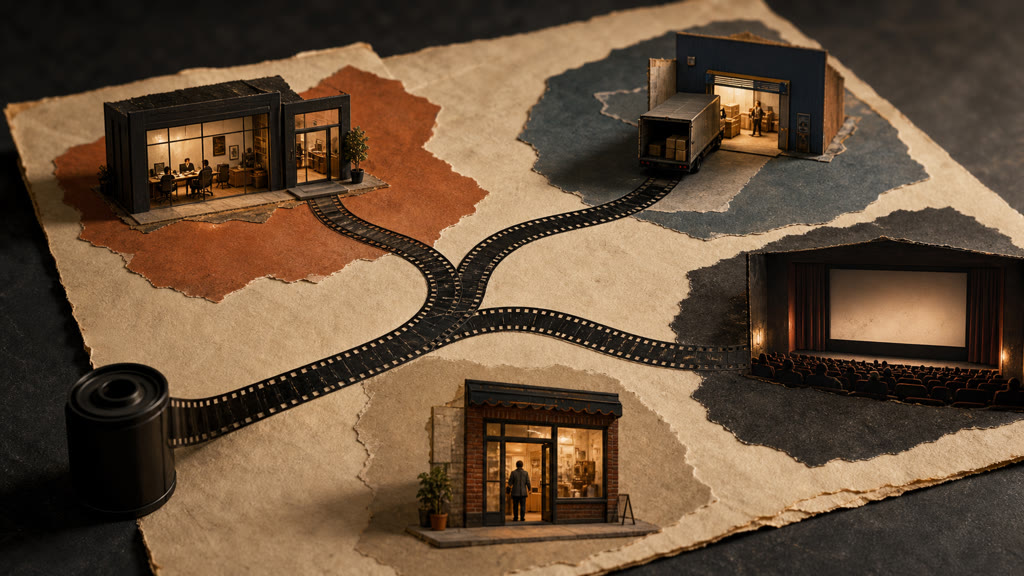
Independent filmmakers in 2026 face two meaningfully distinct distribution paths — not a spectrum of options, but a fork in the road with fundamentally different economics, audience relationships, and long-term career implications.

Path 1: Platform-dependent distribution. The filmmaker routes the film through aggregators and distribution deals, with primary revenue coming from platform placements. Revenue share is 40–60% of gross. Audience data is platform-owned. Launch events are optional or absent. Career infrastructure — buyer databases, warm lists, affiliate networks — does not accumulate. This path is appropriate for films with genuine acquisition potential at the top tier of the market: strong commercial concept, festival credentials, theatrical pathway, and budget aligned with buyer appetite. It is not appropriate — and does not produce meaningful revenue — for the majority of independent films.

Path 2: Direct-to-audience distribution. The filmmaker routes the film through direct distribution infrastructure, with primary revenue coming from a structured premiere event and subsequent TVOD windows. The fee model stays simple, audience data is filmmaker-owned, and launch events are the primary revenue mechanism. Career infrastructure compounds across releases. This path is appropriate for films with a defined niche audience, a filmmaker committed to building direct distribution infrastructure during production, and a production budget where partial recoupment from a 500–2,000 buyer direct launch is economically meaningful. It is the path that produces the highest probability of positive net revenue for the majority of independent films.

What the 2026 market means for filmmakers who are not at the top tier

For the majority of independent filmmakers — those whose films will not secure a Sundance slot, an A24 acquisition, or a Netflix deal — the 2026 market context has one primary implication: the passive distribution safety net has been removed.

The passive distribution pathway — submit to aggregators, upload to streaming platforms, and wait for organic discovery — was always a low-revenue strategy. In 2020–2022, it was at least occasionally viable because streaming platforms were acquiring content at volume, creating a secondary acquisition market for films that demonstrated platform performance. That acquisition market has contracted to near zero for non-prestige independent content.

This means the filmmaker who distributes passively in 2026 is not just generating low revenue — they are generating near-zero revenue on most releases. The alternative is not complicated. It is structured. A filmmaker who builds an email list during production, organizes a structured premiere event using a direct distribution platform like TribuShare, and sequences a 90-day launch plan is operating in a market with growing direct-to-audience infrastructure, a global audience comfortable paying for independent content online, and no algorithmic competitor standing between the filmmaker and their buyer.

Revenue projections for the two distribution paths in 2026

For a documentary with a $30,000 production budget, a 1,200-person warm email list, and a defined niche audience:

VariablePlatform-DependentDirect-to-Audience
Primary distributionAggregator + Amazon + iTunesTribuShare direct premiere
Revenue model~45% filmmaker netSimple direct-sale fee
Premiere eventNoYes — 14-day ticketed window at $14
Year 1 buyers~200 (passive discovery)~360 (12% warm list + secondary)
Year 1 filmmaker net$1,080$4,637
Audience data owned0360 buyer emails
Break-even probabilityLowModerate (Year 2 achievable)

FAQ: independent film distribution in 2026

Is it still possible to sell an independent film to a streaming platform in 2026? Yes, but the conditions have narrowed significantly. The films that secured streaming deals at Sundance 2026 and EFM 2026 shared clear commercial concepts, theatrical pathways, and budget discipline aligned with current buyer appetite. For the majority of independent films, platform acquisition should be treated as a bonus outcome rather than a planned revenue pathway.

What is the most reliable revenue model for independent films in 2026? Direct-to-audience distribution with a structured premiere event — using platforms that provide simple fee economics, buyer data ownership, and premiere event capability — produces the most reliable positive revenue outcome for films with micro-to-low budgets and defined niche audiences.

How has the festival circuit changed in 2026? The festival circuit continues to function as a social proof generator and press catalyst, but its role as a deal-making venue has diminished. Most films that premiere at major festivals in 2026 leave without distribution deals. The strategic value of festivals is in building the credibility and press record that supports premium pricing and buyer conversion in a subsequent direct distribution launch.

What does the Bending Spoons acquisition of Vimeo mean for filmmakers in 2026? The January 2026 layoffs at Vimeo — affecting the majority of its global workforce — have accelerated migration from the platform to direct distribution infrastructure with greater stability and filmmaker-specific feature development. For active distribution use cases, platforms built specifically for film premieres and direct sales are more structurally appropriate than repurposed enterprise video hosting infrastructure.

Final Thought

The 2026 distribution landscape rewards filmmakers who understand the difference between making a film available and launching it. The correction underway in the independent distribution market is not punishing good films — it is ending the era in which passive distribution could approximate a revenue strategy. The filmmakers who navigate the correction are not the ones with the strongest festival credentials or the largest production budgets. They are the ones who treat distribution as a discipline equal to production — and who start building the launch infrastructure before the film is complete.

Stop leaving revenue on the table.

You've built the film. Now build the launch. TribuShare gives you the distribution tools, secured payouts, and full audience ownership
No distributor required.