
How to Build an Email List Before Your Film Release
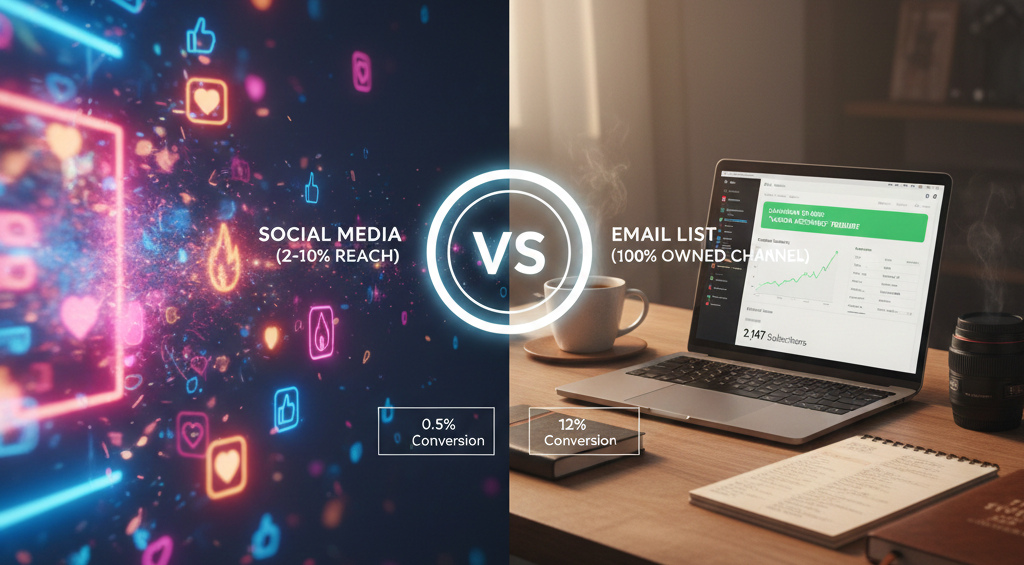
An email list is a distribution asset, not a marketing tool
An independent film without an email list is a product without a sales channel. The email list is not a promotional tool. It is the distribution infrastructure on which every other revenue strategy depends.
The math is direct. A 2,000-contact warm email list, at a 12% premiere conversion rate, generates 240 paid tickets. At a $15 ticket price on a paid TribuShare Pass or Pro site, the 10% + $0.50 sale fee leaves $13.00 per buyer before payment processing: $3,120 in revenue from a single send before processing, marketplace distribution, SVOD placement, or press coverage. The same film launched to 500 unengaged social media followers will typically generate fewer than 20 direct sales from those channels on release day.
The correct frame is that an email list is a direct-to-audience sales channel with a documented return on investment that outperforms every other digital marketing channel. Email marketing delivers an average return of $36 for every $1 spent, according to Litmus's 2024 benchmark data. Email converts at 4.24% for purchase-intent traffic versus 0.59% for social media. Email is also 40 times more effective than Facebook or Twitter for acquiring customers who actually purchase, according to McKinsey's ongoing channel benchmarking.
For filmmakers specifically, the email list carries a structural advantage that no social platform can replicate: you own it. An Instagram account, a TikTok following, and a Facebook page are all assets held on rented infrastructure. Algorithms determine what percentage of followers see any given post, typically 2% to 10% for organic content. An email list sends to 100% of subscribers.
The revenue value of a warm list is calculable before the film is released
| List Size | 12% Conversion | Tickets Sold | Proceeds at $13.00 per buyer (paid Pass/Pro, before processing) |
|---|---|---|---|
| 500 contacts | 60 | 60 | $780 |
| 1,000 contacts | 120 | 120 | $1,560 |
| 2,000 contacts | 240 | 240 | $3,120 |
| 3,000 contacts | 360 | 360 | $4,680 |
| 5,000 contacts | 600 | 600 | $7,800 |
| 10,000 contacts | 1,200 | 1,200 | $15,600 |
The 12% premiere conversion rate applies to warm lists: subscribers who have been consistently engaged throughout production with updates, behind-the-scenes access, and genuine filmmaker communication. Cold lists will not convert at 12%. The benchmark assumes each subscriber has been cultivated as a genuine prospective viewer who already has a relationship with the film.
List building starts during pre-production, not post-production
A list built during pre-production has a structural advantage: time for relationship development. The subscribers who sign up during development have more contact points before the launch than subscribers captured a week before release. Each contact point increases conversion probability. A subscriber who has received eight production updates over six months is more likely to buy a premiere ticket than a subscriber who signed up after seeing the trailer two weeks ago.
Crowdfunding campaigns, if used for financing, are the most efficient list-building mechanism available: every backer becomes a natural email subscriber with pre-existing financial commitment to the project.
Beyond crowdfunding, the development phase offers subject-matter list-building opportunities. A documentary on climate migration can begin collecting emails from climate organization networks, environmental journalism readers, and academic communities, all before a single frame is shot.
The four-phase list-building timeline
Phase 1, Development and pre-production (6–12 months before release)
The objective is to establish capture infrastructure and begin collecting contacts from the film's natural community. The capture infrastructure is a landing page: a simple, single-purpose page with the film's title, a one-line description, a visual, and a sign-up form. The incentive doesn't need to be elaborate: early access to the trailer, exclusive behind-the-scenes updates, or advance ticket access are sufficient.
Phase 2, Production (3–6 months before release)
During production, the list-building objective shifts from capturing to cultivating. The subscribers acquired in Phase 1 receive regular updates: production photographs, short filmmaker notes about what is being shot and why. The frequency should be consistent without being excessive: one email every two to three weeks during active production.
Phase 3, Post-production and festival circuit (1–3 months before release)
As the film approaches completion, the list communication frequency increases and the tone begins shifting toward commercial anticipation. Subscribers should know the release date before it is publicly announced, the list is the first to receive news that matters.
The festival circuit in this phase generates its own list-building opportunity. Every Q&A, panel, or post-screening conversation is a contact-capture moment. A filmmaker presenting at a festival screening can direct audience members to a sign-up link with a QR code on a physical card.
Phase 4, Pre-launch window (4 weeks before release)
In the final four weeks before release, the list transitions from a community asset to a direct sales infrastructure. The communication cadence increases to weekly. Subscribers receive the premiere date, the ticket price, the access link, and (critically) a reason to act now: a premiere window that closes, or an early-bird price available only to list subscribers.
What to send and when: the email content framework
Category 1, Production updates (every 2–3 weeks during production)
Production updates are the relationship currency of the list. They keep subscribers connected to the film's journey. The format is conversational: first-person, specific to what is currently happening. Subscribers who feel genuinely included in the production process arrive at launch day with a sense of investment in the film's outcome.
The subject line should reference something specific, not "Production Update #7" but "The day we almost lost the forest location." Specificity increases open rates.
Category 2, Value content (every 3–4 weeks throughout)
Value content serves subscribers whose primary interest is the film's subject matter rather than the filmmaker's journey. A documentary about independent bookselling should include occasional links to relevant industry coverage or data. This content builds authority and keeps subject-matter subscribers (often the highest-conversion segment) engaged between production updates.
Category 3: Commercial sequences (4 weeks before launch, then at 2-week, 1-week, 3-day, and day-of intervals)
The premiere date reveal, the ticket price announcement, and the launch day reminder each have a specific function. Campaign Monitor data shows welcome emails generate 320% more revenue per email than standard promotional sends, with average open rates above 80%.
Platform comparison: which email tool fits a filmmaker's needs
| Platform | Free Tier | Paid Entry | Data Ownership | Automation |
|---|---|---|---|---|
| Mailchimp | 500 contacts / 1,000 sends/mo | $13/mo | Yes | Limited on free |
| ConvertKit (Kit) | 10,000 contacts free | $29/mo | Yes | Yes |
| MailerLite | 1,000 contacts / 12,000 sends/mo | $9/mo | Yes | Yes on free |
| Substack | Unlimited (free) | 10% of paid revenue | Yes | No |
For most independent filmmakers, the free tier of ConvertKit or MailerLite provides sufficient functionality until the list exceeds 1,000 contacts. TribuShare integrates with the filmmaker's list-building strategy by providing the direct sale endpoint the email drives toward, with a transparent per-sale fee and buyer contact records inside the dashboard.
Common mistakes in filmmaker email list building
Building the list after the film is finished. Cold lists convert below 3%. Warm lists convert at 12%. The difference is time, months of consistent communication that cannot be compressed into weeks.
Optimizing for follower count instead of list quality. A social media giveaway may generate 3,000 followers in 48 hours. Almost none become email subscribers, and even fewer convert to buyers.
Sending only when there is something to sell. Filmmakers who treat email as a broadcast channel are training subscribers to disengage between emails. Consistent, valuable communication between commercial asks creates the relationship capital that converts when the sale is made.
Not segmenting the list before launch. A list of 3,000 contacts contains multiple distinct segments: early adopters, festival attendees, subject-matter subscribers. A launch campaign that treats all 3,000 identically leaves conversion on the table.
Treating the email list as a single-film asset. The buyer database from the first film is the most valuable distribution asset a filmmaker carries into their second project. A filmmaker with 300 buyers from Film A has a proven warm list for Film B.
FAQ
When should I start building an email list for my film? List building should begin during development: ideally 12 months before the planned release date, and at minimum 6 months before. The earlier the list exists, the more contact points each subscriber accumulates before the launch email arrives.
How many email subscribers do I need for a successful film launch? At a 12% conversion rate and a $15 ticket on a paid TribuShare Pass or Pro site, $13.00 remains after the 10% + $0.50 sale fee and before payment processing. One thousand warm contacts therefore generate $1,560 before processing; 2,000 contacts generate $3,120. A filmmaker who spent $20,000 in production should target a list large enough to generate at least 10–15% of production cost on premiere night.
What should I offer to get people to sign up? The most effective email incentives are access-oriented: early access to the trailer, exclusive behind-the-scenes content, advance premiere ticket availability. Giveaways and prize draws generate volume but produce low-quality subscribers.
Does social media make email list building unnecessary? Social media generates discovery. Email converts discovery into purchase. A filmmaker with 20,000 Instagram followers but no email list has reach without a sales channel. A filmmaker with 1,500 email subscribers and 500 Instagram followers has a functioning revenue structure.
Final Thought
An email list is not a marketing channel. It is a distribution infrastructure, the asset that determines whether a film's commercial potential is realized or abandoned on a platform someone else controls. Films that succeed commercially in self-distribution started earlier, built their audience as deliberately as they built their production, and treated every email subscriber as a future buyer rather than a follower. The list is not built after the film. The list is built while the film is built, and it is what makes the launch possible. Continue with email marketing for filmmakers, how to build an email list, and the 30-day launch framework.
