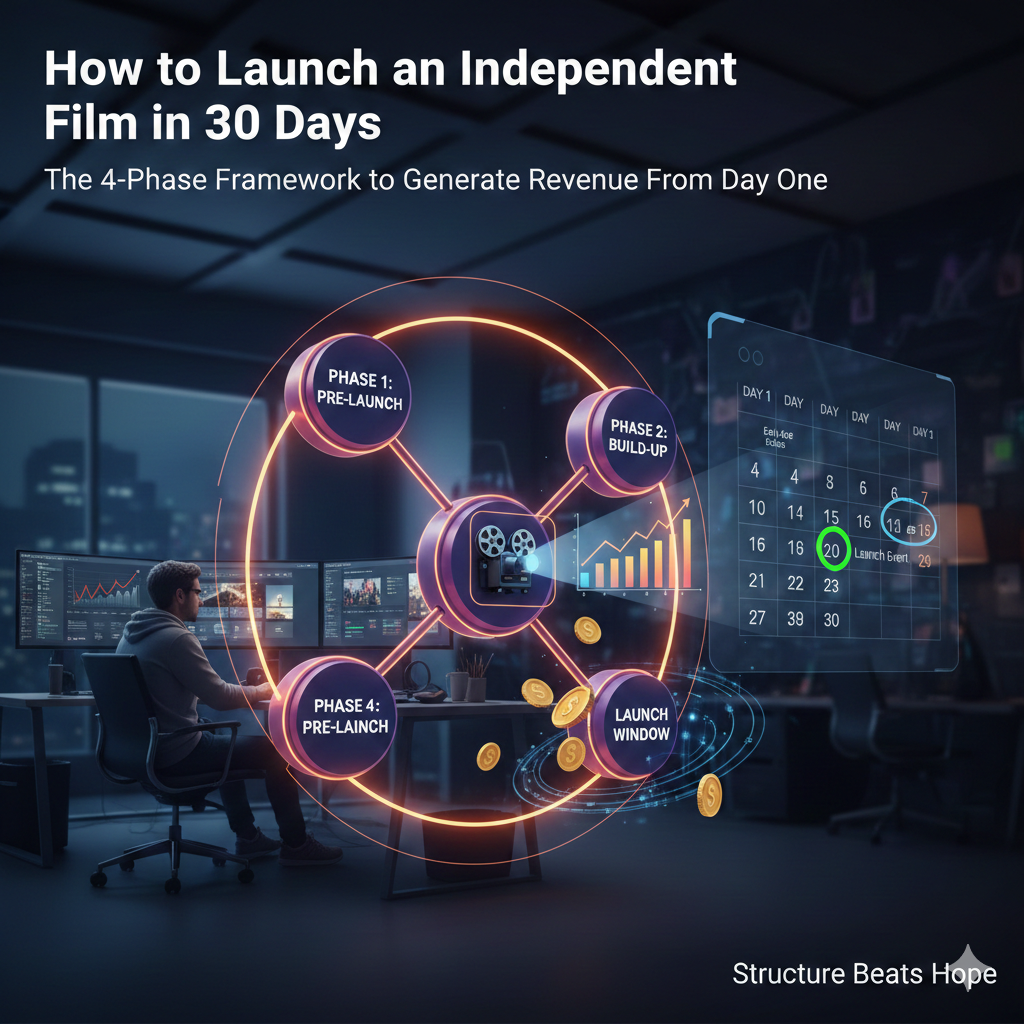
Independent Films Need a Launch, Not a Release Date
Most independent films don't fail because they lack quality. They fail because they never launch. The film gets uploaded to a platform. A few social media posts go out. And then — silence. No concentrated audience attention. No revenue window. No event. Just a file sitting on a server, waiting to be discovered by an algorithm that doesn't care.
This is the default mode for thousands of independent films every year. And it explains why, according to a study analyzing 104 independent films released since 2018, 83% of those distributed through traditional channels never broke even (Filmmaker Magazine, 2023).
A film launch is a structured, time-bound sequence of actions designed to concentrate audience attention, create urgency, and generate revenue within a defined window. It borrows from product launch methodology — the same discipline used by SaaS companies, e-commerce brands, and publishers to turn a release into an event. A release date, by contrast, is a moment. It marks the day a film becomes available. But availability alone generates nothing. No urgency. No scarcity. No reason to act now.
The distinction matters because independent filmmakers operate under a specific constraint: they don't have marketing budgets large enough to sustain months of passive promotion. What they do have is the ability to create a concentrated event — a window where everything aligns: audience readiness, pricing incentive, and emotional momentum. The same Filmmaker Magazine study found that self-distributed films had the highest likelihood of breaking even or generating profit, attributing this to a "more specific, resourced and focused release design." Structure is the variable. Not the platform. Not the budget. The launch.
The 30-Day Framework: 4 Phases From Preparation to Sustained Revenue
The framework below assumes your film is complete (final cut, poster, trailer ready) and that you have at least a seed audience — even if it's only 200 email subscribers or a social following built during production. If you have zero audience, the first step is building one, which is covered in a separate guide on building an email list before your film release.
| Phase | Timeline | Objective |
|---|---|---|
| 1 — Pre-launch | Day 30 to Day 14 | Set up infrastructure, capture audience, build anticipation |
| 2 — Build-up | Day 14 to Day 3 | Create urgency, activate email sequence, open early access |
| 3 — Launch window | Day 3 to Day +3 | Concentrate revenue, run the event |
| 4 — Post-launch | Day +3 to Day +30 | Sustain momentum, open second revenue window |
Each phase has a distinct purpose. Skipping one doesn't save time — it leaks revenue.
Phase 1 — Pre-Launch: Set the Foundation (Day 30 to Day 14)
The pre-launch phase is where most independent films lose before they start. This is the infrastructure phase — the 16 days where you build everything that will make your launch window effective.
Sales Page Setup
Your film needs its own dedicated sales page. Not a Vimeo link. Not a social media profile. A page you control, with a clear value proposition, a trailer, pricing, and a call to action. This page is the destination for every piece of communication during the next 30 days. If viewers can't find a single, clear place to pay and watch, you have no launch — you have a scavenger hunt.
Pricing Decision
Set your price before anything else. This seems obvious, but many filmmakers delay this decision until launch day, which means their entire communication lacks a concrete offer. For independent films, pricing typically falls into three structures: single ticket (pay-per-view), early bird with limited-time discount, or bundled access (film + behind-the-scenes + Q&A). The right choice depends on your audience size and film type. A separate article covers how to price your independent film in detail.
Email Capture
If you don't have an email list, this is the most important action in Phase 1. Every other channel — social media, press, word of mouth — should funnel toward one goal: getting an email address. Email is the only channel you own. Social followers are rented. Email subscribers are yours. A list of 500 engaged subscribers will outperform 10,000 passive Instagram followers in revenue terms, every time.
Content Drip
During pre-launch, release 3 to 5 pieces of content that build anticipation without giving away the film. This can include: a 60-second behind-the-scenes clip, a director's note explaining the film's origin, a short interview with a cast member, or a still gallery with context. Each piece should drive viewers to the sales page or the email signup.
Milestone for Phase 1: By Day 14, you should have a live sales page, a set price, an email list (even small), and 3–5 pieces of anticipation content published.
Phase 2 — Build-Up: Create Urgency (Day 14 to Day 3)
The build-up phase transforms interest into intent. The goal here is not to inform — that was Phase 1. The goal is to create a reason to act within a specific time window.
Announce the Launch Date
This sounds basic, but the announcement itself is a content event. Frame it clearly: "On [date], the film becomes available for [price] for a limited time." The words "limited time" are not decoration. They are the mechanism. Scarcity converts better than availability — this is one of the most documented principles in behavioral economics, and it applies directly to film distribution.
Activate the Email Sequence
Between Day 14 and Day 3, send 3 to 4 emails to your list — not promotional blasts, but a sequence with escalating specificity. Email 1 (Day 14) announces the date, explains what the film is about, and links to the trailer. Email 2 (Day 10) shares something personal — why you made this film — to build emotional connection. Email 3 (Day 5) is an early access offer, giving subscribers the option to buy or reserve before the public launch, rewarding your most engaged audience and generating revenue before launch day. Email 4 (Day 3) is the final reminder: the launch window opens in 72 hours.
Early Access Window
Opening a 48- to 72-hour early access period for email subscribers serves two purposes. First, it rewards loyalty. Second, it generates the first wave of revenue before public launch, which builds social proof and momentum. Early access buyers become your first advocates — they talk about the film before the general audience even sees it.
Milestone for Phase 2: By Day 3, you should have a firm launch date communicated, an email sequence sent, and early access revenue confirmed.
Phase 3 — Launch Window: Concentrate the Event (Day 3 to Day +3)
This is the core of the framework. The launch window is a 6-day period — 3 days before public launch and 3 days after — where every action is designed to maximize revenue concentration.
Revenue concentration means generating the highest possible percentage of your total revenue within the shortest possible time window. This matters because attention decays. The first 72 hours after public launch will account for the majority of your total revenue — if you structure the window correctly.
Day 0: Public Launch
The film goes live for everyone. All channels activate simultaneously: email to the full list, social media posts, any press coverage, and the sales page goes from "coming soon" to "watch now." Every piece of communication should have one message: the film is available now, for a limited time, at this price, here.
Live Event Layer
If possible, add a live event to the launch window. This could be a live Q&A with the director after the first screening, a virtual watch party where the audience watches together in real time, or a ticketed online premiere with a countdown. The live element creates urgency that a static sales page cannot. An event has a start time. A start time creates a deadline. A deadline creates action.
Days +1 to +3: Post-Premiere Push
The first three days after launch are where social proof compounds. Share viewer reactions (with permission). Highlight the number of people who watched during the premiere. Send a "last chance" email to non-buyers on your list. If you set a limited availability window, remind the audience that the clock is ticking.
Milestone for Phase 3: By Day +3, you should have generated the majority of your total launch revenue. If the launch window is structured correctly, 60–70% of your total 30-day revenue should come from this 6-day period.
Phase 4 — Post-Launch: Sustain and Extend (Day +3 to Day +30)
After the launch window closes, the intensity drops — but the strategy doesn't stop. Phase 4 is about capturing the long tail of demand and preparing for a potential second revenue window.
Post-Launch Email
Send a recap to your full list. Include social proof: how many people watched, a few testimonials, and a clear CTA for anyone who missed the premiere. This single email often converts 10–15% of the remaining non-buyers because it combines scarcity (they missed the event) with proof (others loved it).
Second Revenue Window
After 7–14 days of reduced availability (or complete unavailability), consider reopening access at a different price point or in a different format. This could be a higher regular price (making the launch price feel like a deal in retrospect), a bundle with bonus content, or access on a different platform. The gap between windows is what creates scarcity. Without the gap, there is no urgency to act the second time.
Audience Data Analysis
By Day +30, you should have a clear picture of your launch performance: total revenue, conversion rate from email list, geographic distribution of buyers, peak viewing times, and average transaction value. This data informs every future decision — from your next film's pricing to your marketing channel allocation. Independent filmmakers who track this data operate as businesses. Those who don't are guessing.
Milestone for Phase 4: By Day +30, you should have total launch revenue calculated, audience data documented, and a decision made on the second revenue window.
Why 30 Days Changes the Economics of Self-Distribution
The traditional approach to independent film distribution operates on hope: upload the film, list it on platforms, and wait for revenue to accumulate over months or years. This passive model suffers from a structural flaw — it relies on sustained discovery in an environment where new content floods every platform daily.
A 30-day launch framework inverts this logic. Instead of hoping for steady trickle, it designs for concentrated impact. The math is simple: 500 viewers paying $10 in a 7-day launch window generates $5,000. The same 500 viewers spread over 12 months of passive availability might generate the same revenue — or they might not, because without urgency, most of them never pay.
The global independent film distribution market reached $5.4 billion in 2024 and is projected to grow at a 7.2% annual rate through 2033 (DataIntelo, 2025). But this growth benefits filmmakers only if they can capture their share of it. Passive distribution hands that capture to platforms and algorithms. Structured launches — built on infrastructure like TribuShare, which gives filmmakers full pricing control and audience data ownership — keep it in the filmmaker's hands.
Frequently Asked Questions
Can I launch a film in 30 days if I have no email list? You can, but your results will be limited. The email list is the single highest-converting channel for film launches. If you have zero subscribers, dedicate Phase 1 entirely to list building: offer a free behind-the-scenes clip or an exclusive trailer in exchange for an email address. Even 100–200 subscribers give you a launchable audience. A list of 500 engaged subscribers will consistently outperform 10,000 passive social followers in revenue terms.
What if my film is already on a VOD platform? A launch framework works even for films already listed on platforms. The difference is that you layer an event on top of existing availability — a ticketed premiere, a live Q&A, or a limited-time pricing window. The platform provides access; the launch provides urgency.
How much revenue can I realistically expect? This depends entirely on your audience size, pricing, and conversion rate. A filmmaker with a 1,000-person email list, a $12 ticket price, and a 10% conversion rate generates $1,200 in the launch window alone. The same filmmaker with passive distribution and no launch structure might generate $200 over 6 months — or nothing.
Do I need a large social media following? No. Social media supports a launch, but it doesn't drive it. Email drives launches. Social media's role is to push people toward your email list or your sales page. A filmmaker with 500 email subscribers and 200 social followers will outperform a filmmaker with 50,000 followers and no email list.
Should I make my film free first to build an audience? No — unless you have a specific, downstream monetization plan. Making a film free signals that the film has no commercial value. If your goal is revenue, price the film from day one. You can offer early bird discounts or bundled pricing, but free removes the transaction layer entirely, and transactions are what sustain filmmaking careers.
Final Thought
A film that launches in 30 days generates more revenue than a film that sits for 12 months. Not because the film is better — but because the structure is. Uploading is not distribution. Availability is not strategy. A launch is a designed event with a beginning, a peak, and a deliberate end. Independent filmmakers who understand this don't need bigger budgets. They need a framework. The platform is secondary. The launch is primary.