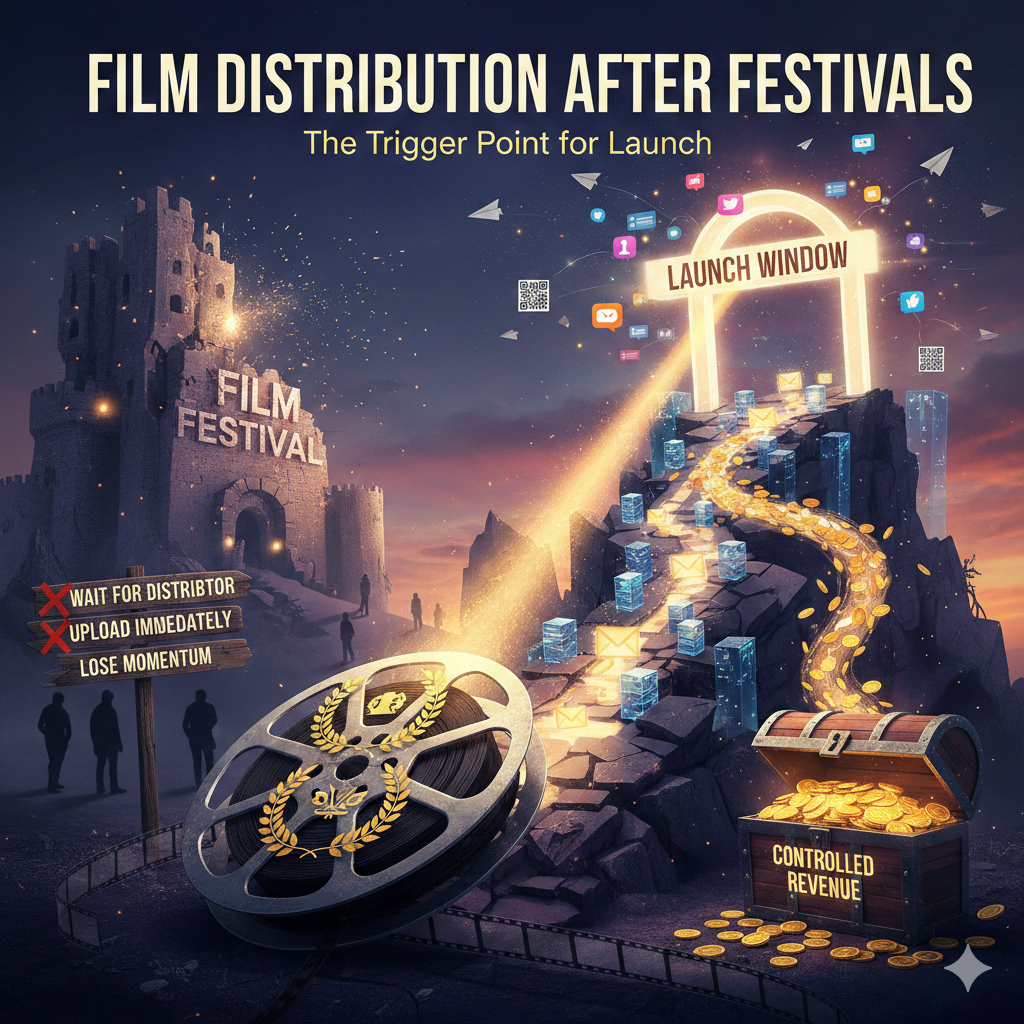
Why the Post-Festival Phase Is Where Distribution Begins
For many independent filmmakers, the festival circuit feels like the culmination of years of work. The premiere, the audience reactions, the Q&A sessions, the laurels — these moments represent genuine achievement and hard-earned recognition. But they also create a dangerous illusion: that the work of reaching an audience is done.
In reality, festivals are the midpoint of your distribution journey, not the endpoint. A festival run creates visibility — press mentions, reviews, audience buzz, industry connections. What it does not create is a distribution system. And without a structured post-festival plan, the momentum generated by even the most successful festival run disappears faster than most filmmakers expect.
The real question after festivals is not: "Who will pick up my film?" It is: "How do I convert this attention into controlled revenue?"
The answer lies in treating festival visibility as raw material — powerful but perishable — that must be rapidly converted into infrastructure: an audience you own, a launch you control, and revenue you can measure.
What Festivals Actually Give You (And What They Don't)
Understanding this distinction is essential for making smart decisions in the post-festival window.
Festivals give you credibility assets: press mentions and reviews that create social proof, awards and laurels that signal quality to potential viewers, networking opportunities with industry professionals, and authentic audience reactions that can shape your marketing messaging. A viewer who tells you "this film changed how I think about..." has given you a marketing headline.
But festivals do not give you sustainable revenue, audience ownership, launch infrastructure, or a long-term distribution strategy. Festival screenings generate no direct income for most filmmakers. Unless you actively collect contact information, the people who watched and loved your film are invisible to you. Festivals provide a stage, not a system — there is no payment processing, no email marketing integration, and no dependable reporting workflow you control.
Festivals generate spikes. Spikes without structure collapse. The art is in converting a spike into a sustained system.
The Biggest Post-Festival Mistake
Most filmmakers make one of three moves after their festival run ends — and all three are suboptimal.
Waiting for a Distributor That Never Materializes
Many filmmakers spend months after their festival run waiting for a distribution offer. They attend markets, take meetings, and send screeners. Some receive offers. Many don't. And during this waiting period, every day that passes reduces the value of their festival momentum. Attention is perishable — six months after your last screening, press interest has moved on, audience memory has faded, and your bargaining position has weakened.
Uploading Immediately to Streaming Platforms
The impulse to "get the film out there" is understandable but strategically harmful. Uploading to a marketplace without a launch plan removes urgency, eliminates scarcity, and positions your film as just another catalog entry. There is no premiere moment, no concentrated attention, and no reason for anyone to watch today rather than "someday."
Doing Nothing and Losing Momentum Entirely
Some filmmakers, exhausted from the festival circuit and unsure of their next step, simply pause. They intend to figure out distribution later. But later becomes never, and the window of opportunity created by their festival success closes permanently.
All three options dilute the festival peak. The correct move is to convert visibility into a defined launch window — a structured, time-bound release event that capitalizes on festival credibility while the attention is still warm.
The 5-Step Post-Festival Launch Plan
Step 1 — Capture the Festival Audience Immediately
Before you think about platforms, think about ownership. During screenings, place a QR code on your Q&A slides that links to a landing page with an email signup. Mention the URL verbally during introductions. Have physical cards available at the venue. During press interactions, direct every journalist to your film's landing page — not your personal social media. After screenings, share follow-up posts that link to the landing page and engage with audience members who post about your film. If you leave a festival run without capturing contacts, you have attention without leverage. Attention must become data. Data becomes leverage. Leverage becomes revenue.
Step 2 — Define Your Post-Festival Launch Window
Do not release randomly. A random release date is barely a release at all — it is an upload with a timestamp. Choose a defined online premiere date that your audience can mark on their calendar. Set a 7–14 day ticketed launch period during which the film is available through your direct channels at premiere pricing. Build a structured communication plan — a sequence of emails, social media posts, and press outreach that builds anticipation before the premiere and sustains engagement throughout the window. The ideal timing is within 30–90 days of your last significant screening. Long enough to prepare properly, short enough to capitalize on existing attention.
Step 3 — Use Festival Assets Strategically
Your laurels, reviews, and press mentions are not decorative achievements. They are conversion tools. Use them to increase perceived value on your landing page, justify premium ticket pricing, build authority on your film's website, and strengthen email campaigns. Subject lines like "Award-winning film now available for exclusive premiere" perform significantly better than "My film is now online." Social proof increases conversion during launch windows — use it deliberately and prominently.
Step 4 — Structure an Online Premiere
Instead of passive availability, organize a launch event. Sell paid tickets — pricing communicates value. Set a limited-time screening window of 48 hours, 72 hours, or one week to create natural urgency. Include a live Q&A or watch party to transform a solo viewing experience into a shared event. Offer exclusive bonus access — behind-the-scenes footage, director's commentary, or a digital booklet — available only to premiere ticket holders.
Festival buzz + event-based release = revenue concentration. This is the formula that turns attention into income.
Step 5 — Expand After the Peak
Once the premiere window closes, shift from concentration to expansion. Offer replay access at a reduced price point. Release educational licenses to universities and cultural institutions. Approach niche communities aligned with your film's subject matter. Expand to additional platforms — once you have premiere revenue, reviews, and viewer data, marketplace listings carry more weight. Momentum compounds: success in the premiere phase creates assets that strengthen every subsequent distribution channel.
The Hybrid Strategy That Works
The most effective post-festival distribution model follows a deliberate sequence that protects revenue at each stage:
- Festival run — build credibility, capture contacts, generate press
- Direct, ticketed online premiere — monetize the attention peak with a premium, controlled event
- Controlled launch window — maintain urgency through a defined availability period
- Secondary digital availability — replay access, bundles, and expanded offerings
- Long-term marketplace presence — passive catalog listing for ongoing discovery
This approach protects early revenue by capturing the highest-value sales first, ensures audience data ownership from the start, maintains pricing control throughout the lifecycle, and reduces dependency on distributors by building direct infrastructure.
The impulse to upload immediately to a marketplace after festivals is understandable, but it removes urgency, spreads attention thin, reduces pricing power, and eliminates scarcity. Availability without timing weakens perceived value. Timing is leverage — and leverage is what turns attention into income.
Should I wait for a distributor after festivals? Waiting without a parallel strategy is risky. Distributors may take months to decide, and momentum fades quickly. A structured self-launch plan protects your leverage and generates revenue regardless. If a distributor does come along, you negotiate from strength — with premiere data, audience numbers, and proven revenue.
When should I release my film after festivals? Ideally within 30–90 days of your last significant screening, while festival visibility is still fresh. Delay beyond this window significantly reduces conversion potential.
Can festivals help self-distribution? Absolutely. Festivals generate credibility and visibility that are difficult to create from scratch. The key is using festival assets strategically within a structured launch — not treating them as passive accomplishments.
Is it better to go straight to streaming? Streaming platforms can support long-term availability, but immediate passive release almost always reduces launch revenue. Capture the revenue peak through a direct launch first, then expand to streaming platforms as a secondary channel.
Final Thought
Festivals create attention. Launch structure creates revenue.
If your festival run generated interest — if people told you they loved your film, if critics wrote about it, if audiences leaned in during your Q&A — your next move should not be passive distribution. It should be a controlled, event-driven release that transforms visibility into income.
The festival is not the end of your distribution journey. It is the trigger point for your launch. What you build after the festival determines whether that attention becomes revenue or simply a fond memory.