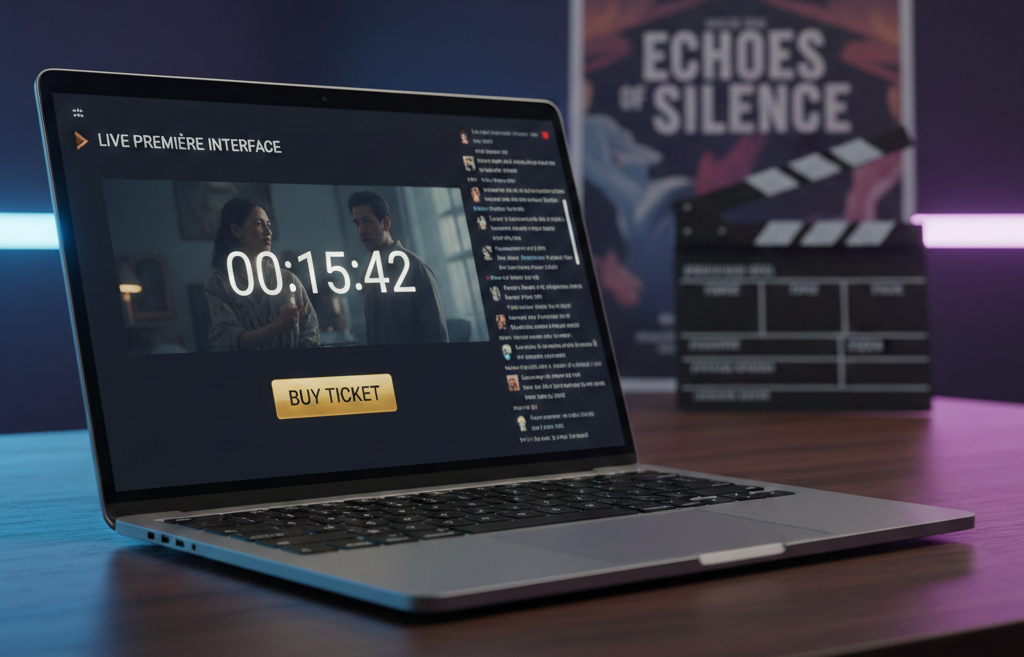
How to Structure a Watch Party That Generates Revenue

What makes a watch party a revenue event rather than a free screening
The difference between a watch party that generates revenue and one that doesn't is architecture, not attendance. Filmmakers who host free watch parties for their email lists (hoping that goodwill translates into later purchases) consistently find that it doesn't. Free access at any point in the distribution window signals to the audience that the film has a free tier, which suppresses paid conversion in every subsequent window.
There are two structural models for revenue-generating watch parties.
Model A: Watch party as premiere ticket benefit. The watch party is a scheduled screening within the launch window, available exclusively to buyers who have purchased a premiere ticket. Buying the premiere ticket grants access to the watch party: it is one of the event layer benefits that justify the premiere price. Watch party inclusion consistently raises premiere conversion by 2–4 percentage points: translating to 20–40 additional buyers on a 1,000-person warm list.
Model B: Watch party as standalone ticketed event. The watch party is its own event with its own ticket price, separate from the premiere TVOD purchase. Attendees buy a watch party ticket that grants access to a specific screening at a specific date and time, with filmmaker participation. This model is most effective as a re-premiere format: applied to films that have already been distributed, where the watch party is the new event rather than an extension of the original premiere.
Pricing: what a watch party ticket is worth
$10–$15 per ticket. The standard range for an independent film watch party with filmmaker participation (pre-show address, post-screening Q&A, or live chat commentary). This range is consistent with cinema ticket pricing in most markets.
$8–$12 per ticket. Appropriate for watch parties without live filmmaker participation, or for films where the community alignment is strong enough that the shared experience itself is the primary value proposition.
$18–$25 per ticket. Justified when the watch party includes significant exclusive value: a pre-show with a subject matter expert, a filmmaker panel with multiple participants, a post-screening workshop, or limited capacity that creates genuine scarcity.
Group ticket pricing is an underused mechanism for watch parties. A filmmaker who offers a "group watch" rate ($8 per person for a minimum of four viewers) activates the social recruitment mechanism: buyers who have already purchased recommend the watch party to their networks as a group activity rather than individual consumption.
Watch party timing within the launch window
Days 5–9 of the launch window: optimal. A watch party scheduled in the middle of the premiere window serves as the primary mid-window conversion event. Subscribers who opened the premiere announcement but did not purchase in the opening days have a new decision trigger. The watch party announcement email (sent on Day 4 or Day 5, announcing a Day 7 or Day 8 screening) generates a mid-window conversion spike that compensates for the natural trough in Days 4–10 of a 14-day premiere window.
Day 1 of the launch window: not recommended. A watch party on premiere opening day compresses the event timeline and reduces the mid-window re-engagement opportunity.
Day 13–14 (close day): not recommended. A watch party on close day collides with the close date urgency email and dilutes the urgency message.
Post-window: standalone event. A watch party scheduled 2–4 weeks after the launch window closes functions as a re-engagement event for the buyer database and a secondary acquisition event for post-window TVOD buyers.
Technology: platforms and tools for online watch parties
Film delivery. Two practical approaches: synchronized streaming (all viewers watch at the same time) and access-window viewing (ticket holders receive a time-limited private link valid for a specific 24-hour period). Synchronized streaming produces the strongest community experience but requires infrastructure. Access-window viewing is operationally simpler and accommodates multiple time zones.
For audiences under 500 viewers, synchronized streaming through Vimeo Live, StreamYard, or YouTube Live (unlisted) is technically manageable. For audiences above 500 viewers, access-window viewing with a dedicated real-time chat channel (Discord, Slack) provides a viable substitute.
Communication. A Discord server or dedicated Slack workspace, set up before the watch party and shared with ticket holders upon purchase, allows pre-event community building, real-time screening commentary, and post-screening discussion. Filmmakers who host watch parties without a communication layer consistently report lower engagement.
Commerce. Watch party tickets are sold through the same premiere platform used for the TVOD premiere, TribuShare or an equivalent platform that supports event-based ticketing with filmmaker-controlled buyer data.
Watch party formats: four models and their revenue outcomes
Format 1, Async watch party with filmmaker commentary. Film available for 48–72 hours with an exclusive filmmaker commentary track. No synchronized timing. Revenue model: ticket sales ($10–$15) for the commentary + film access bundle. Operational complexity: low.
Format 2: Live watch with pre-show and post-show. Synchronized screening at a specific date and time, with a 15–20 minute filmmaker pre-show before the film and a 30–45 minute Q&A after. This is the most common format and produces the strongest balance of community experience and operational feasibility. Revenue model: ticket sales ($12–$18).
Format 3, Live watch with real-time filmmaker commentary. Synchronized screening with the filmmaker providing live commentary throughout the film. Revenue model: ticket sales ($15–$22). Most appropriate for films where the filmmaker's production process is itself interesting to the audience.
Format 4 (Panel watch event. A watch party with multiple participants) the filmmaker plus cast, crew, subject matter experts, or critics. Revenue model: ticket sales ($18–$30). Operational complexity: highest.
Revenue projections by format and audience size
Format 2: Live pre/post-show, $14 ticket:
| List type | List size | Conversion | Buyers | Gross revenue |
|---|---|---|---|---|
| Warm premiere list | 300 | 20% | 60 | $840 |
| Warm premiere list | 750 | 18% | 135 | $1,890 |
| Warm premiere list | 1,500 | 16% | 240 | $3,360 |
| Post-window re-engagement | 500 | 10% | 50 | $700 |
Format 4: Panel event, $22 ticket:
| List type | List size | Conversion | Buyers | Gross revenue |
|---|---|---|---|---|
| Warm premiere list | 300 | 15% | 45 | $990 |
| Warm premiere list | 750 | 14% | 105 | $2,310 |
| Warm premiere list | 1,500 | 12% | 180 | $3,960 |
| Post-window re-engagement | 500 | 8% | 40 | $880 |
A filmmaker with a 1,500-person warm premiere list who executes a Format 2 watch party generates $3,360 gross in this model. Apply the site's fee, processing, taxes, refunds, and promotion splits to calculate net proceeds.
The re-premiere watch party: applying the format to previously distributed films
The watch party is the most effective re-premiere mechanism for films that have already been released. A film that has been available on streaming platforms for 12–24 months can be re-premiered as a watch party event without requiring the filmmaker to pull it from existing platforms, the watch party is positioned as a new experience rather than a new release.
The re-premiere watch party has three prerequisites: a rebuilt email list (the filmmaker who distributed passively has zero buyer email addresses), new event content (filmmaker retrospective, panel with new participants, or subject matter developments), and a specific re-premiere reason ("the [anniversary / award recognition] watch party" converts 3–5x higher than "we're screening the film again").
Common mistakes in film watch party execution
Hosting a free watch party as a "sample." Free access during or adjacent to the launch window does not convert into paid purchases later. It converts paid buyers into free viewers by establishing a free access tier.
Scheduling the watch party before the premiere is sold. A watch party scheduled before sufficient premiere tickets are sold creates an event with low attendance and low community energy. Schedule the watch party for Days 5–9 of the launch window, after the opening spike has generated an initial buyer community.
Not testing the technology before the event. A live watch party with technical problems during the film destroys the community experience the event is designed to create. Test every component (film delivery, Q&A platform, chat channel, payment confirmation) in a full rehearsal at least 48 hours before the event.
Not recording the Q&A. A filmed Q&A or post-screening discussion can be packaged as bonus content included with premiere ticket purchases or sold as a standalone purchase. A filmmaker who hosts a compelling Q&A and doesn't record it has created a community experience that has no downstream revenue function.
FAQ: film watch parties
How many people do I need for a watch party to be worth organizing? A watch party with 30 buyers at $12 per ticket generates $360 gross. Net proceeds depend on the site's fee with or without Premium, payment processing, taxes, refunds, and any promotion split. The threshold for organizational viability also depends on the filmmaker's time cost. For most filmmakers, 25–30 paying attendees can justify the Format 2 model. Format 4 (panel event) requires more coordination.
Can I run a watch party for a film that's already on Netflix or Amazon Prime? If the film is available on subscription platforms, the watch party ticket cannot be priced at the standard TVOD level, buyers know they can watch the film without purchasing the ticket. The ticket price must be justified entirely by the event layer (filmmaker participation, exclusive discussion) rather than film access. Price the watch party at $8–$12 and position it explicitly as "filmmaker Q&A + group screening" rather than film access. This framing is accurate and justifies the price for the community experience even when the film is freely accessible.
Final Thought
A watch party generates revenue when it is designed as a revenue event first and a viewing experience second. The film is the anchor. The event is the product. A filmmaker who hosts a watch party without a ticket price, a defined close date, and a filmmaker participation element has organized a screening. A filmmaker who structures a watch party with a tiered ticket price, a mid-window schedule, a Discord community channel, and a recorded Q&A has organized a revenue event that adds 25–40% to their premiere revenue from the same audience. The film is the same. The structure is the difference. Pair the watch party with a paid online premiere, ticketed premiere pricing, and a scarcity window.